
Deed Types Recorded in Cass County
Every deed moves an interest in land from a grantor to a grantee. In Cass County, deed records live in the same Register systems. Alongside them sit mortgages, discharges, assignments, land contracts, easements, and plats. The label on a document helps narrow a property search. But its legal weight comes from the signed instrument. The chain of recordings around it matters too.
| Deed Type | What It Does | Common Use |
|---|---|---|
| Warranty deed | Transfers title with stated covenants | Ordinary arms-length sale |
| Quit claim deed | Transfers the interest the grantor has, if any | Family, trust, or title cleanup transfer |
| Trustee or fiduciary deed | Transfers through an authorized trust or estate role | Trust administration or probate |
| Land contract | Records terms of an installment land purchase | Seller-financed transfer |
| Tax conveyance | Documents an interest after statutory tax proceedings | Delinquent-tax property |
Mortgages and liens are encumbrances, meaning recorded claims against land rather than a transfer of ownership. A discharge releases a mortgage. An assignment shifts the lender's interest to someone else. Read these related instruments together, and don't assume every index row marks a new owner of record.
Cass County Has Two Deed Portals
The legacy Register index reads like a deep card catalog. Basic and advanced searches cover party names, dates, liber and page, document and tracking numbers, parcel, subdivision, lot, block, tract, unit, and section-township-range fields. Its own notice warns that entries can be incomplete or misspelled. The index is not the document itself.
The newer Keystone portal keeps things simple with five tabs: Name, Date Range, Liber/Page, Doc Number, and Parcel Number. Each result lists the record date, two party columns, document number and type, parcel, municipality, related documents, and a cart. A Turnstile check may appear. Page and certification prices only show during checkout.
The portals overlap, but they suit different habits. Keystone is concise. The older index carries deeper legal-description keys. Those matter for a rural tract or a city lot whose street address changed over time.
Search Fields for Cass Deeds
Start with the narrowest key that works, then widen the query only if needed. A known instrument number beats a broad surname search. Book and page are strong when you already have a cited deed. Parcel and subdivision fields help when a party's spelling is unclear. A date range keeps a common name manageable.
| Register field | Format or option | Useful when |
|---|---|---|
| Grantor or grantee | Last and first name, exact or partial behavior | A transfer party is known |
| Liber and page | Book and page; ranges supported in legacy search | Another record cites the deed |
| Recording date | From and to dates | A closing period is known |
| Document number | Keystone example yyyy-xxxxxxx | An exact recording reference is known |
| Parcel number | Portal-specific number or suffix | A current parcel card is known |
| Legal fields | Subdivision, lot, block, section, township, range | The land description is known |
The Cass County deed search accepts legacy syntax that makes queries more flexible. Spaces can separate values, a colon defines a range, pipes mark alternatives, and numeric wildcards fill gaps. The help text suggests trying spelling variants, and it recommends deselecting "Search All Types" before picking focused document categories in the property records.
The Cass Deed Date Conflict
Two official county sources give different starting dates for the deed index. The live legacy index shows coverage from November 1, 1988 through April 6, 2026. An older county copy-request PDF instead says November 1, 1992 to the present. That is a four-year conflict between two Cass County materials. It should stay visible. Rather than smoothing the records into one unsupported date, keep both figures noted. Either one could match what a searcher actually encounters in the deed records.
Coverage clue. Treat the live 1988 date as the current portal statement, but ask the Register for any missing or earlier book.
The current Keystone landing screen publishes no complete starting date of its own. Online coverage is not the same as the age of the deed record series, and a web form that stops early does not erase the rest. Cass County was set off in 1829. Older land records survive in books, indexes, plats, library collections, and archives, so a deed search that hits the digital boundary still has places to turn.
Follow Cass County Grantor-Grantee Entries
A grantor gives an interest in land. A grantee receives it. The chain of title is the ordered series of instruments affecting the same parcel. Tracing it well takes patience. Start with the newest reliable deed reference you hold. Then use each seller's earlier purchase to move back through time one transfer at a time. Match the land itself, not just a similar name. Exact property identity is what keeps the deed chain sound.
- Find the present owner's acquiring deed by searching that owner as grantee.
- Read the grantor, legal description, parcel, recording date, and reference.
- Search that grantor as a grantee in an earlier date range.
- Repeat while the land description stays consistent, noting splits and related instruments.
- Move to deed books, older indexes, or staff help when the web coverage ends.
- Grantor
- The party transferring the recorded interest.
- Grantee
- The party receiving the recorded interest.
- Chain of title
- The linked sequence of instruments for the same land.
- Book and page
- A volume and page citation, also called liber and page.
- Instrument number
- A unique recording identifier assigned to one document.
A land contract, fiduciary deed, quit claim between relatives, or parcel split can break a clean chain of title in Cass County. Pull the related deed records and match the full legal description before stepping back to an earlier owner of record.
Mortgages and Releases in Cass Records
Keystone's document menu lists Mortgage, Discharge of Mortgage, and Assignment of Mortgage. Those rows reveal debt recorded against the land. They also show who later held the security interest, and whether a release was filed. None of them, standing alone, proves ownership changed hands.
Land contracts and easements deserve their own reading. A land contract can reflect a seller-financed purchase. An easement, by contrast, grants a defined use or access right. Rights-of-way, covenants, and plats all shape how the property gets used. Cass County cautions that its staff cannot perform the full abstract work. Such work would be needed to examine every such interest.
Note: Use “Find Related” controls where offered, since a later discharge or assignment can point back to the original recording.
Cass Deeds Before Online Coverage
Deed research in Cass County often begins on paper rather than on screen. The Library of Michigan Cass County guide points to three helpful leads: an 1872 landowners index and the C. O. Titus atlas. An 1888 assessment roll completes the set. Any one of them can surface a clue. A surname, tract, township, range, or plat find is worth carrying to the Register. Treat them as leads, though. A historical atlas proves nothing about current title.
Rural Cass County deeds describe land by section, township, range, direction, and acreage. Village property turns instead on plat, lot, and block. When a name fails online, try a legal-description phrase instead. The Register's older books remain open. Old newspapers add probate notices, sheriff sales, and road references. For stubborn index gaps, the Cass District Library Local History Branch offers still another access channel. The Archives of Michigan offers one as well.
A Fireproof Home for Cass Records
Cass County records once sat at the old Cassopolis House. An 1860 county history says officials answered that risk. They authorized a fireproof county office building. That story concerns security, not any named deed book. Modern Michigan retention rules call county property records permanent. Deeds, easements, rights-of-way, restrictive covenants, annexations, detachments, incorporations, and supporting maps all stay.
This history separates web access from record survival. A portal cutoff reflects digitization and indexing. It does not mark the creation of the first Cass County deed records. When an online name search stops early, ask the Register. Request the underlying volume or permanent series.
Tapestry Adds a Cass Search Route
Tapestry EON is the newest route into Cass County deed records. The official recorded-document page announced its launch on June 12, 2026. Casual or one-time searchers pay $8.75 per search, and the county notice remains the safest entry point for a working link.
Tapestry now joins the older routes. A free legacy index, public courthouse workstations, and direct copy requests all predate it, as does the current Keystone interface with its five-tab search and purchase path. Weigh cost against depth before paying. A paid search is not a title opinion. The counter still matters for early or missing volumes.
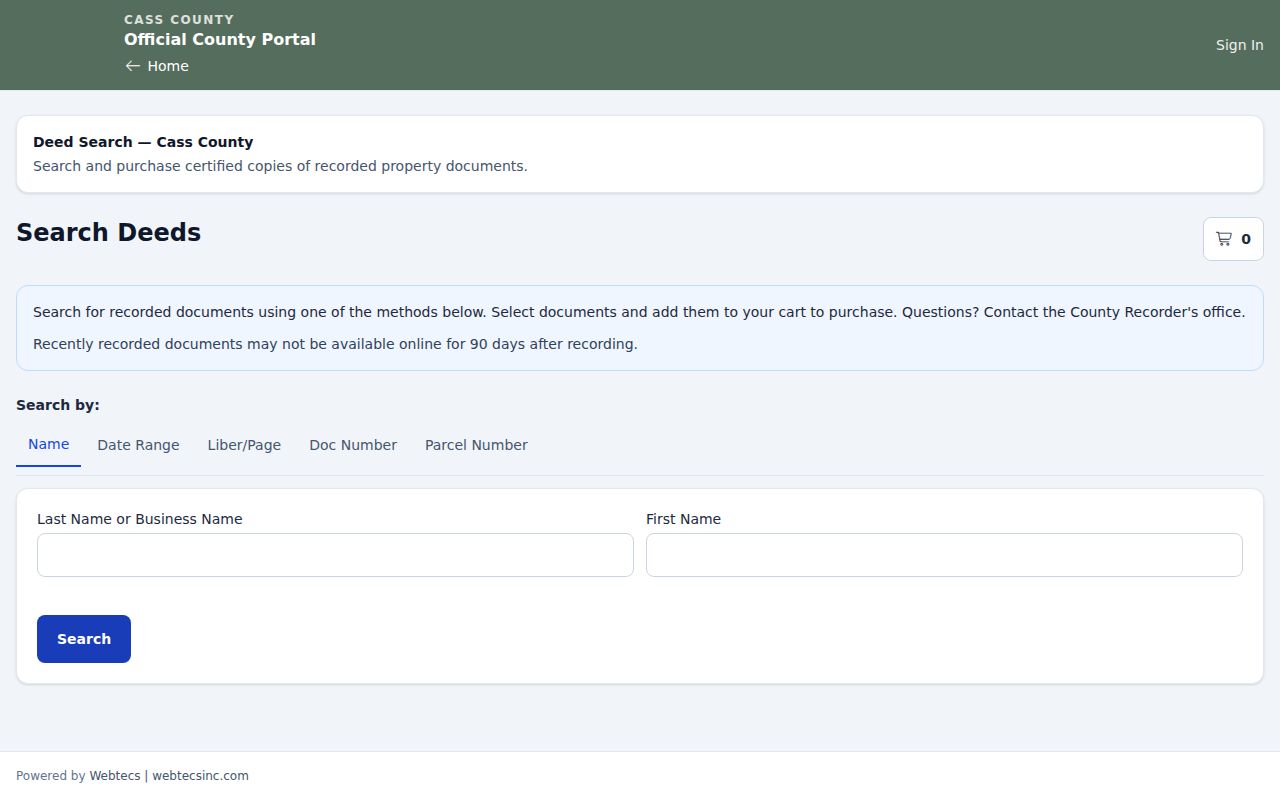
Each clue gets its own lane here. Party, date, book and page, document number, and parcel searches sit in separate fields rather than one blended form.
Request a Cass County Deed Copy
Copies come several ways. The online cart works when the image and needed pages are available. County email works at clerk@cassco.org. Phone requests go to 269-445-4464. Public workstations at the Administration Building offer free index research, and printed images run $1 per page plus processing.
The recorded-document request form accepts mail, fax, or email submissions. Enter liber and page directly if you have them. Otherwise the form takes a name, document type, approximate date, sale or mortgage amount, grantor, and grantee, with name-only searching at a nonrefundable $25 per name. Mail reaches the Register of Deeds, 120 N Broadway, Suite 123, Cassopolis, MI 49031, and fax goes to 269-445-4406.
Recorded, not guaranteed. Cass County deed records show indexed instruments, not a complete title opinion; unrecorded interests or missed entries may still exist.
Check certification and delivery options with the Register before paying. A dispute needs deeper review. For a purchase or full title review, a title company or Michigan attorney can examine the complete chain of title and its exceptions.