
The Cass County Owner-of-Record Card
Every current-owner check starts with the assessment roll. Cass County's assessment notice carries the exact label OWNER'S NAME & ADDRESS/PERSON NAMED ON ASSESSMENT ROLL. That label names the person or entity held for assessment. It is not an occupant listing. Nor is it a title opinion. The parcel ID links that owner field to GIS and the Register of Deeds.
| Owner name | Person or entity named on the current assessment roll |
|---|---|
| Mailing address | Where assessment and tax correspondence goes |
| Situs address | The parcel's physical location or access address |
| Parcel ID | The key for matching map, assessment, and deed records |
| Deed book/page | A lead to the recorded transfer instrument |
| Sale date and amount | Transaction context that requires deed confirmation |
The owner mailing address helps with legitimate correspondence. It may be an office, a post-office box, or an address outside Cass County. It does not establish who lives at the situs. When a trust, company, or estate holds title, the roll can show the entity rather than an individual's name.
Find the Current Cass Owner in BS&A
Cass County links its property data through the BS&A Online portal. Searches run by Address, Name, or Parcel Number. The parcel mask reads 14-999-999-999-99. Search by address when the location is known. Capture the displayed PID before checking the name. A name-only search can join unrelated owners or miss a spelling variation.
Fees differ by searcher. Cass County's property-tax page lists public searches at $6 each from September 5, 2023, while owners can create an account and pull information on their own properties without that charge. The portal's public parcel card asks you to sign in, so confirm the live field labels and update year rather than assuming every ArcGIS field appears in BS&A.
The Correct Assessor Depends on the Tax Unit
Cass County keeps no single county assessor for every owner card. Local assessors serve particular cities, villages, and townships. The official assessor roster assigns named officials by unit. Shalice Northrop covers Dowagiac and several townships, Bill Gibert covers Milton and Ontwa, and other units list separate contacts.
Pick the assessor by tax unit, not mailing city. A postal address can read Edwardsburg, Cassopolis, Dowagiac, or Niles while the parcel legally sits in a township. Give the assessor the PID, situs, owner spelling, and assessment year when asking whether the owner record is current. That detail speeds the answer.
Why the Cass Owner Roll Can Lag a Deed
Cass County Equalization runs a May-to-April annual cycle. Recorded deeds and other documents move through that period. Local assessors prepare rolls in January and February. Change notices issue in February, Boards of Review act in March, and the equalization report wraps up around April or May. The county publishes no standard number of days between closing and an owner-field update. That lag is simply not fixed.
A transfer recorded after the assessment snapshot can therefore name a newer grantee than the roll. Note the assessment year and the deed recording date, and treat any mismatch as a timing clue rather than proof of an office error.
Recent-sale check. When a roll and deed disagree, the newest recorded deed is the stronger current-owner lead; ask the local assessor when its roll will refresh.
Cass Parcel Data Separates Owner and Situs
The public Cass Tax Parcels feature service exposes OwnerName1, OwnerName2, FullOwnerAddress, FullSitusAddress, PID, LegalDescription, SaleDate, SaleAmount, DeedBook, and DeedPage. That field list builds a strong current-owner inventory, though the raw service is not a polished assessor card.
Owner mailing address, situs, and legal description differ. A split or combination can create a new PID. Keep each field separate, since an earlier deed may still carry the former legal description after a split. When identifiers conflict, the deed reference settles it. Cross-checking is easier with the full schema. The field inventory on the ArcGIS service shows the county parcel attributes available for confirmation.
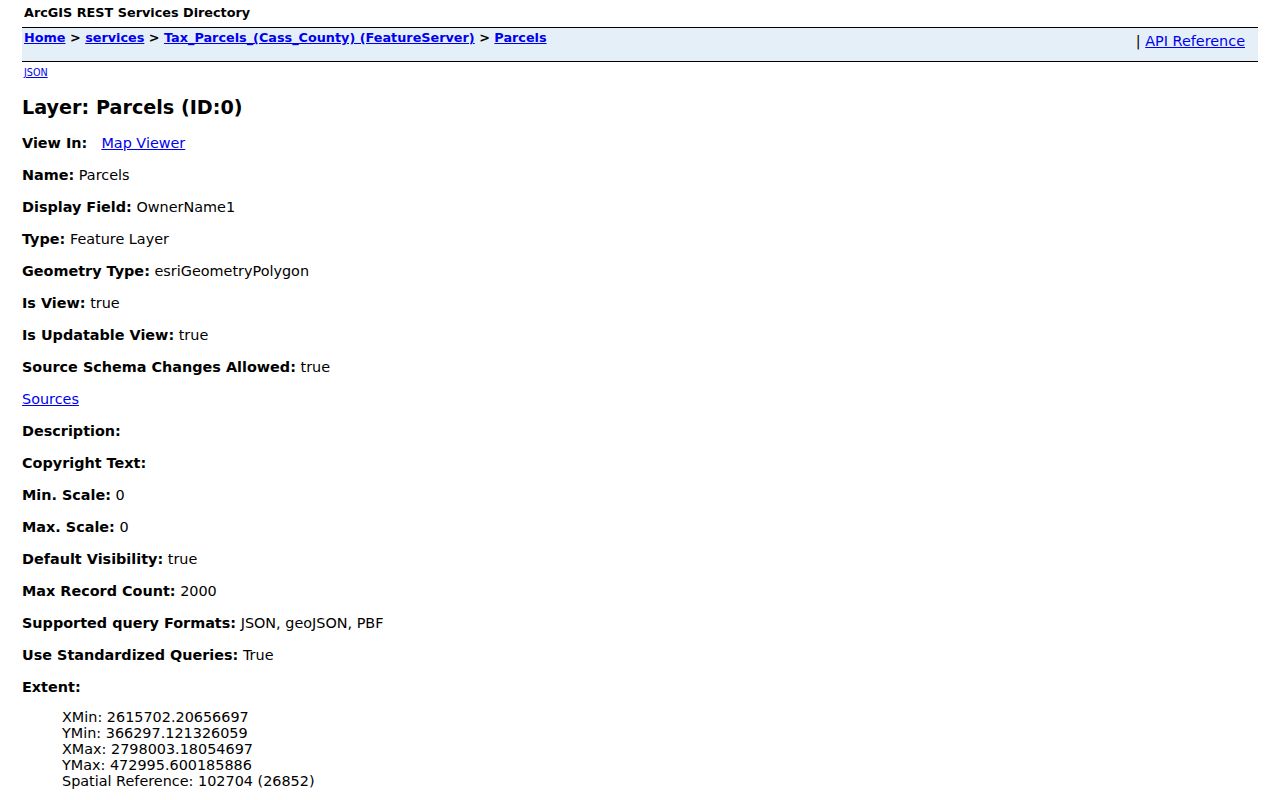
A field list is only a starting point. Check the roll year and the newest recorded transfer before trusting any owner value from the data.
Confirm the Current Cass County Owner
The Register of Deeds holds the recorded transfer evidence. The current Keystone portal searches by Name, Date Range, Liber/Page, Document Number, and Parcel Number. Results show the recording date, both parties, document type, parcel number, municipality, and related documents. Match the legal description, not just the name.
- Read the owner name, PID, situs, mailing address, sale fields, and deed reference from current parcel sources.
- Search Keystone by parcel number and search that owner as grantee.
- Choose the newest deed that transfers the matching legal description, not a mortgage, release, or easement.
- Compare its recording date with the roll year and contact the assessor about a lag.
- Owner of record
- The party carried as owner in a particular official record.
- Vesting
- The deed language describing how title is held.
- Registered agent
- A business entity's designated legal contact, not necessarily the beneficial owner of its land.
Use Both Cass Register Search Routes
The Register offers two search routes. The legacy index begins November 1, 1988. An older request form instead states coverage from November 1, 1992 to present. Treat the live index as the current coverage statement. Ask the office about missing or earlier books. The legacy system shines for subdivision, lot, block, tract, unit, section, township, range, parcel, and both-names searching.
Keystone offers a cleaner five-tab search with related-document links. Public workstations sit in the Administration Building. The official recorded-document page lists printed images at $1 per page plus processing, and an identified latest deed can be requested at clerk@cassco.org or 269-445-4464.
When the Current Owner Is an LLC or Trust
Copy the entity's name and punctuation exactly as the tax roll spells it. Then search that name in both grantee and grantor roles. Michigan's MiBusiness Registry has been online in its current form since June 23, 2025. It can pull up a company record along with available certificates or copies. It cannot make the registered agent the property owner. A trust often shows only the trust or trustee name. An estate transfer may need probate context to sort out who holds authority. Even then, the recorded deed remains the land-record evidence. It should match the parcel's legal description.
A Cass Current-Owner Verification Checklist
| Check | Evidence to save | Reason |
|---|---|---|
| Parcel identity | PID, situs, legal description | Avoid same-address and split-parcel errors |
| Roll timing | Assessment year and owner label | Expose a recent-sale lag |
| Latest transfer | Grantee, recording date, document number | Confirm present vesting lead |
| Entity identity | Exact trust or company name | Avoid substituting a similarly named party |
| Custodian response | Assessor or Register confirmation | Resolve unclear or missing online data |
Run the address search and the parcel search separately. Addresses change; parcels persist. A parcel number can shift after a division or combination, but the legal description keeps the record continuous. When a deed search returns several documents, compare the municipality, the parties, the recording date, the deed type, and any related-document references before choosing the current transfer. Pick the document that matches best. Never infer present ownership from the sale amount alone. A deed can reflect a transfer even when the consideration is nominal, or when the parcel data has not refreshed yet. A mortgage names parties, too. It does not replace the vesting deed. Saving the exact document number makes any office follow-up much faster. This present-owner checklist stops at the latest transfer. For earlier owners, the Cass County former owners workflow walks the grantor-grantee chain backward.
Use Cass Current-Owner Records Lawfully
The assessment mailing address suits a respectful letter. A boundary question, a purchase inquiry, or an estate matter are all legitimate property business. The address does not establish residence, though. Michigan's Address Confidentiality Program gives eligible people at risk a designated address with mail forwarding. Program information stays shielded from ordinary FOIA disclosure. The assessor roll is not a title search. The Register says its office cannot perform an in-depth title examination either. Easements, rights-of-way, mineral interests, and every other potentially relevant instrument may call for a title company or an attorney.
Lawful use. Current-owner information is for legitimate property research. Never use a public owner or mailing field to stalk, harass, intimidate, or harm anyone.