
What Cass County Property Tax Records Reveal
No single bill holds everything. Cass County property tax records combine several linked files instead. Assessor and parcel data carry the value and classification fields. The Treasurer's side holds payments and delinquencies. The public ArcGIS parcel service adds context too, including land, building, improvement and total property values, plus taxing district, sale date, sale amount and legal acreage.
| Field | What It Shows | Where |
|---|---|---|
| Assessed value | Half of true cash value under Michigan's assessment framework | Local assessor and BS&A |
| Taxable value | The value used with millage rates to calculate tax | Assessment notice and tax record |
| Land, building and improvement values | Components in the parcel data inventory | ArcGIS parcel service |
| Tax bill and status | Current taxes, payments and delinquency | BS&A and County Treasurer |
| Taxing district | The unit tied to assessment and tax administration | Parcel record |
Assessed value, taxable value and sale price answer different questions. Michigan law pegs assessment at 50 percent of true cash value. Taxable value is capped by statute. It can uncap after a transfer. A recorded sale amount is one transaction's evidence, not the assessment itself. For interpretation rather than bill mechanics, see the Cass County property value guide.
BS&A Search Keys for Cass County Taxes
The county's Property Tax Search page opens BS&A Online. Its landing page lists Current Tax Search, Assessing Search, Delinquent Tax Search, Detailed Record Search and payment services. Public searches cost $6 each under county guidance. That fee has applied since September 5, 2023. An owner who creates an account gets a break. That account holder can view information for the owner's own property without the search charge.
| Search tab | Entry format | Best use |
|---|---|---|
| Address | Street address, such as 123 Main St | Known physical location |
| Name | Last name, first name | Finding parcels associated with a taxpayer |
| Parcel Number | Mask shown as 14-999-999-999-99 | Most precise cross-system key |
The Cass County tax-search page displays the official entry point alongside its fee notice. View the Cass County tax-search source directly.
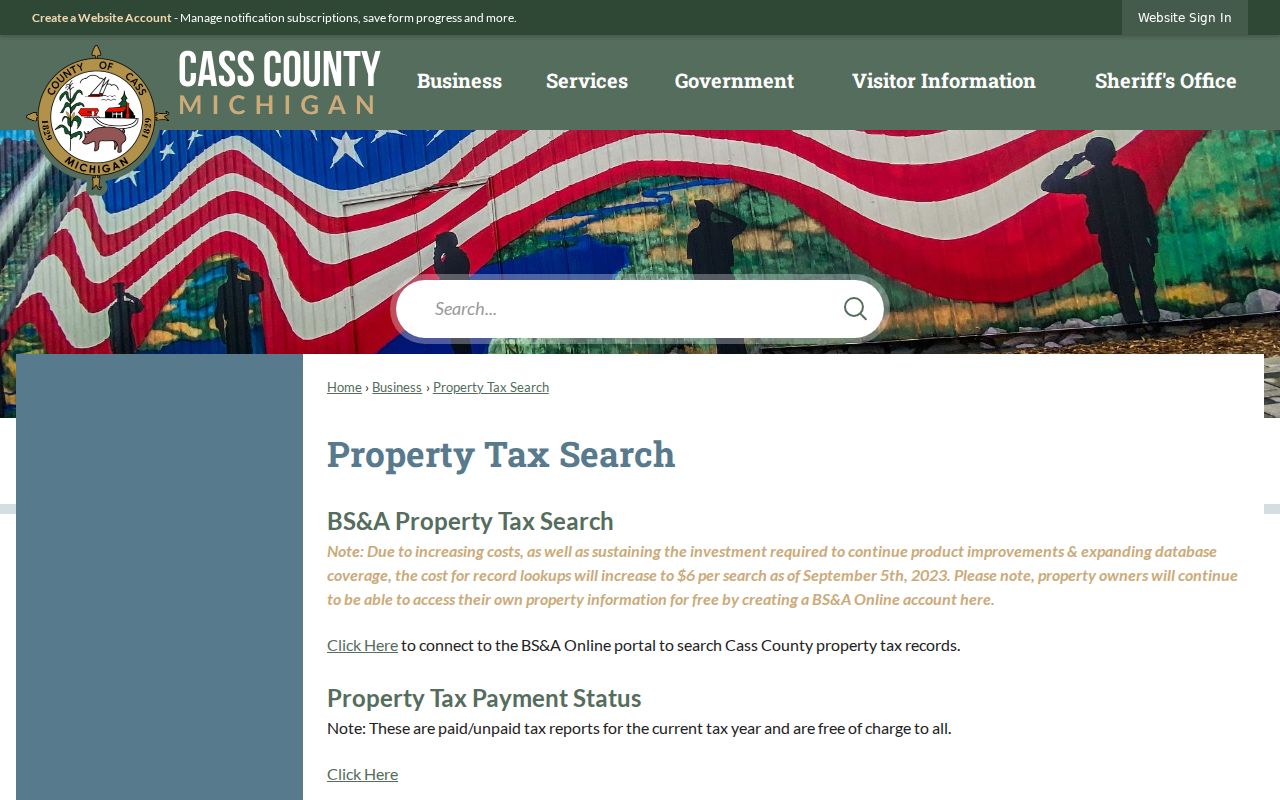
Treat the county page as your starting reference. Preserve the parcel number shown in the result. You will need it for later calls or written requests.
Note: Field availability can vary by record, so confirm the fields you need against the live BS&A result.
Cass County Values Begin With Local Assessors
Cass County assigns assessors by city, village or township. The county's assessor roster lists them all. Shalice Northrop handles Howard, Jefferson, Marcellus, Newberg and the City of Dowagiac. Other named assessors cover groupings across the county. These include LaGrange, Pokagon, Wayne, Mason, Porter, Volinia, Milton, Ontwa, Penn and Silver Creek. Check the property tax unit on the parcel record. It points to the right assessor for a valuation or exemption question.
This local-unit structure matters. Two similarly addressed parcels can sit in different municipalities. A mailing city can differ from the legal taxing unit. Contact the assessor with the parcel ID, legal municipality and tax year in hand. County Equalization coordinates and reviews the assessment rolls. It does not replace the local assessor's record.
The May-to-April Cass Assessment Cycle
Cass County Equalization describes a yearly May-to-April cycle for processing deeds and recorded documents. Assessors prepare their rolls in January and February. Change notices issue in February. Boards of Review meet in March. The county report is finalized around April or May, which is why a just-recorded transfer and the owner line on an assessment notice may briefly disagree.
- May through year-end: recorded changes feed the next assessment cycle.
- January and February: local assessors prepare values and notices.
- March: Boards of Review hear timely challenges.
- April and May: equalization reporting is completed.
Equalization publishes no exact lag for an individual transfer. Pair the recording date with the notice year instead of assuming the tax roll updates on closing day.
Look Up a Cass County Tax Bill
Start with the BS&A record. Then call the Cass County Treasurer. Treasurer Hope Anderson's office, at 120 N Broadway in Cassopolis, confirms delinquent balances, foreclosure status and payoffs, and can be reached at 269-445-4468.
- Search BS&A by address, owner name or parcel number.
- Confirm the municipality and tax year before reading current or delinquent status.
- Compare the assessment notice for taxable value and exemption treatment.
- Ask the Treasurer to verify delinquency, payoff or foreclosure information before acting.
- Assessed value
- The statutory assessment measure, generally 50 percent of true cash value.
- Millage or levy
- The rates applied to taxable value by the relevant taxing authorities.
- Principal residence exemption
- Michigan treatment for a qualifying principal residence; verify eligibility and filing with the assessor.
- Tax lien
- A governmental claim arising from unpaid property taxes.
Delinquency and the 2026 Online Auction
Delinquent real-property taxes belong to the Treasurer. The office publishes auction and tax-sale information each cycle. The county calendar listed an online-only real-property tax auction for August 6, 2026. An auction notice is an access event, not proof that a named parcel sold or that every title issue vanished.
A careful check spans several offices. Confirm the Treasurer's current balance, then read the foreclosure judgment or related court file. Court indexes can identify a case. The clerk's file holds the underlying order, the Register supplies the land-record evidence, and this multi-office check matters most for estate, quiet-title or foreclosure complications.
Cass County Exemption and Notice Records
Exemptions run through the local assessor under Michigan rules. Principal-residence, poverty and veteran-related forms are the usual routes, though eligibility depends on the applicable form and the facts. Start with the parcel's tax unit. Get the current form from the assessor. Keep proof of filing. If an exemption notation is missing, raise it with that office directly rather than treating it as a final denial.
The assessment notice matters too. Its owner field reads “OWNER'S NAME & ADDRESS/PERSON NAMED ON ASSESSMENT ROLL.” That label describes the roll, not a title opinion, so after a just-completed sale check the latest recorded deed through the Cass County deed records route.
Appeal a Cass County Assessment
An assessment challenge in Cass County starts locally. File a petition with your assessing unit's March Board of Review. Read the notice as soon as it arrives. Verify the parcel number and classification. Build your case around the correct valuation date. Michigan Treasury publishes the L-4035 petition and Board of Review instructions. Deadlines and filing routes change. Confirm both with your local unit before the current year's window closes.
Strong evidence makes the difference. Bring a precise property description and photographs of the condition. Add comparable sales and an appraisal if you have one. Include documents that fix factual errors like acreage or building details. Remember that a tax bill dispute and an assessment dispute are separate matters. Route each question to whichever Cass County office actually controls it.
Appeal window. Cass local Boards of Review act in March. Confirm the current meeting and petition deadline with the property’s assessing unit immediately after receiving the February notice.