
Trace Cass County Former Owners
A backward deed chain identifies the former owners of one Cass County parcel. Start with the newest instrument. Each deed names a grantor and a grantee. That grantee is the grantor you hunt next. Keep the legal description, recording date, document number, and book and page together as a worksheet rather than a claim about any particular property.
| Transfer point | Grantor to grantee | Instrument clue | Reference to save |
|---|---|---|---|
| Latest transfer | Prior owner to present grantee | Recorded deed type | Document number or book/page |
| Prior transfer | Earlier grantor to latest grantor | Warranty or quit claim deed, as indexed | Recording date and reference |
| Earlier transfer | Earlier grantor to prior grantee | Recorded instrument type | Parcel and legal description |
| Pre-online link | Name and tract from older source | Deed book, plat, or assessment entry | Volume, page, lot/block, or section |
The Keystone deed portal lists party names, recording dates, instrument types, municipality, parcel number, related documents, and a purchase control. Those fields keep a chain tied to the same land. The work is not just ordering one deed. It reconstructs prior owners across linked entries.
The county's current Keystone interface shows all five deed-search routes first.
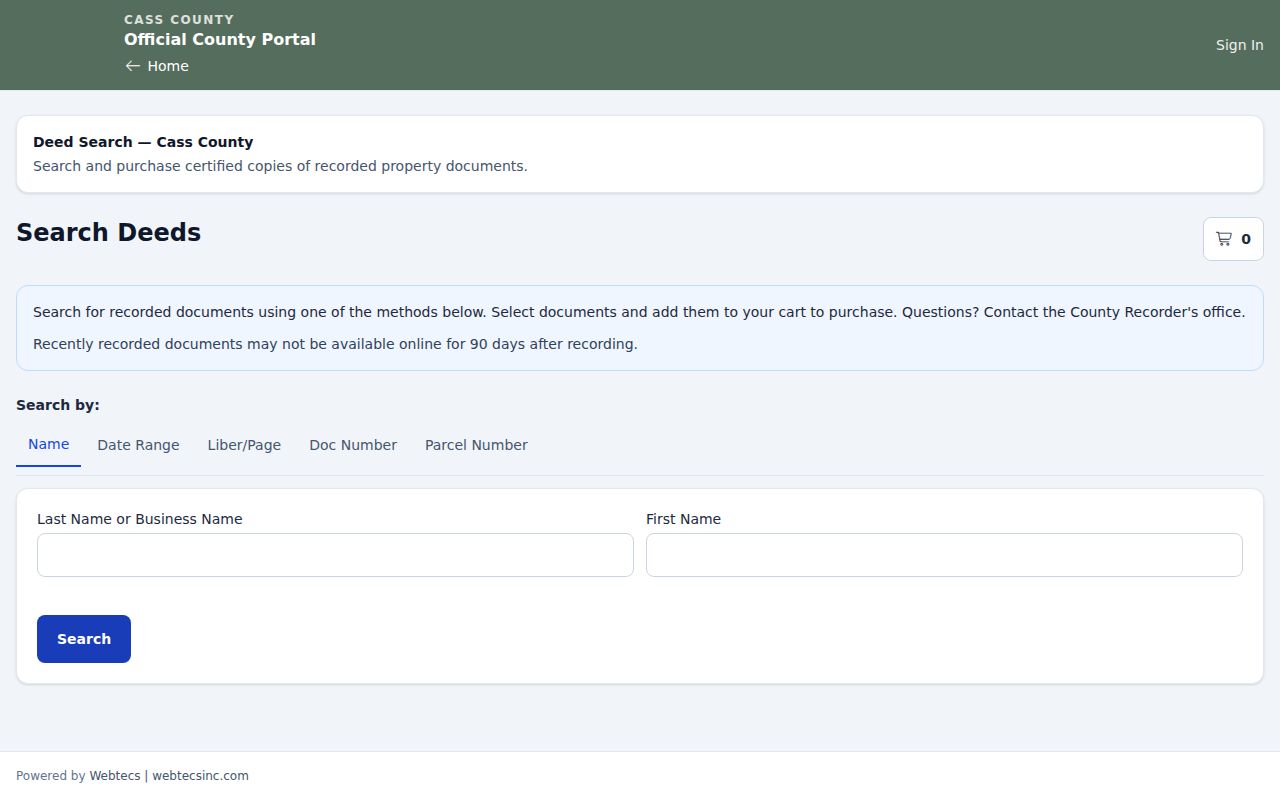
The tabs for name, date, liber/page, document number, and parcel each unlock a different link in a backward chain of Cass County owners of record.
Cass County's Latest Deed
The newest deed sets the first backward step. Look up the address in the county assessment system. Note the PID and legal description. Then find the newest matching instrument in the Register. The grantee received the stated interest. The grantor is your next prior-owner name. A sale date or book-and-page hint from the parcel service helps, but the recorded instrument controls the wording of the transfer. Match the parcel, municipality, legal description, and related documents, since a same-name hit alone is weak evidence when a person appears across unrelated Cass County land records.
Walk Cass County Ownership Backward
Grantor and grantee fields make a reverse search orderly. Log every transfer in writing. Do not skip a deed for a close filing date, and never treat a mortgage or discharge as a change of Cass County ownership.
- Find the current owner's acquisition deed with the owner listed as grantee. Confirm its parcel or legal description.
- Record the grantor's full indexed name, deed type, recording date, and document or book/page reference.
- Search that grantor as a grantee in an earlier date range. Test spelling variants and both-name fields when needed.
- Repeat the match by land description, not just by name. Move to office books and older sources once web coverage ends.
- Grantor
- The person or entity conveying the stated property interest.
- Grantee
- The person or entity receiving the stated property interest.
- Chain of title
- The ordered sequence of recorded instruments affecting ownership.
- Reverse index
- An index arranged to locate entries through grantor or grantee names.
- Warranty deed
- A deed form carrying covenants stated in the instrument.
- Quit claim deed
- A deed conveying the grantor's stated interest without the same warranty form.
For the wider document search and copy process, see the Cass County deed records page. Former-owner work stays on sequence and time depth.
Cass County's Online Record Boundary
The legacy Register index states that Cass County deed coverage begins November 1, 1988, with a published verification date of April 6, 2026. An older county request form tells a different story. It gives November 1, 1992 to the present. The live index is the more current statement, but the gap matters whenever an early result is missing from the property records.
Online cutoff. Treat November 1, 1988 as the current stated starting point, and ask the Register to check earlier or absent books.
A blank result is not a blank history. Older Cass County deeds may wait in deed books, old indexes, or archives. Public workstations at the Administration Building allow free index research. Prints run $1 per page plus processing.
Note: Keep the 1988-versus-1992 conflict in mind. That way a missing deed is not mistaken for a clean break in the property records.
Cass County Descriptions Link Owners
Street labels change. A legal description persists. The legacy Register search covers subdivision, lot, block, tract, unit, section, township, range, and quarter section. It also reaches sixteenth section. Those fields keep former-owner work alive when an old deed lacks a modern address.
Platted village and city parcels usually follow subdivision, lot, and block. Rural Cass County land leans on section, township, range, acreage, and metes-and-bounds language. Splits, combinations, and lot-line adjustments can create new parcel numbers. Then compare the prior deed and related documents instead.
1872 and 1888 Owner Clues
The Library of Michigan Cass County guide points to an 1872 landowners index, the 1872 C.O. Titus atlas, and an 1888 assessment roll. All three reach well past the online deed boundary. Each supplies an owner or plat clue.
The bridge runs from an old name or tract into section-township-range or lot-and-block language. That language then enters the Register's older index and deed books. An atlas label is historical evidence. It is not proof of title. It earns its place only when a later recorded deed confirms that the same description passed through the named owner.
Modern searches revolve around a PID. The oldest sources organize land differently, sorting by owner, acreage, rural survey coordinates, or a village plat instead.
Cass County Plats and Notices
Historic plats and newspaper notices can bridge gaps between former owners. The Library of Michigan guide lists the Cassopolis Vigilant from 1872 through 2016, the Edwardsburg Argus from 1879 through 2016, and the Dowagiac Times from 1887 through 1906. Sale, probate, foreclosure, and plat notices often carry names and description text. It points back to a recorded instrument.
Treat every notice as a lead. Confirm its liber and page, document number, parties, and parcel description at the Register. A subdivision plat works the same way. It explains lots and blocks, but a later Cass County deed chain shows which interest actually passed and when.
Estate Transfers in Cass County
Estates, trusts, and fiduciaries can interrupt an otherwise clean seller-to-buyer chain in Cass County. Probate papers show who had the legal power to convey the land. The Register of Deeds, meanwhile, holds the instrument that actually entered the property record. Search each decedent, estate, personal representative, trustee, or related party under both grantor and grantee roles. Then compare every hit against the same legal description on the parcel.
The Cass Courts site offers routes into Probate Court records, and the local probate file room holds the underlying public files. A case file explains the authority behind a transfer. It does not substitute for the recorded deed. The two sources answer different parts of a property's history.
Cass County Former-Owner Limits
Former owners in Cass County can only be rebuilt from property records. Those records must have survived. They must also have been indexed correctly. The Register itself states that it cannot perform an in-depth title search or abstract. Misspelled names complicate things. So do parcel splits, odd consideration amounts, trust roles, and interests that never got recorded. A simple chain built from deed records alone can stay incomplete.
Any high-stakes ownership question calls for a title professional. That professional must examine every relevant deed, easement, right-of-way, mineral interest, restriction, lien, and release. A historical chain still has real value. It supports house history, estate work, plat research, and purchase diligence. Each claim must stay tied to its source document.
Lawful use. Cass County former-owner records support property research, but they must never be used to stalk, harass, threaten, or expose anyone.